
In 2026, the traditional referral model has been overtaken by a digital-first reality. 96% of potential clients use a search engine to find legal advice, and for most, the search begins and ends on Google. The days of asking a neighbor for a recommendation are fading. Today, when individuals face an urgent legal crisis, they pick up their phones and search for a solution immediately.
If your practice isn’t visible at that exact moment, you are losing high-intent leads to competitors who have invested in a comprehensive law firm seo strategy.
High-intent leads are typically in a crisis. They are probably facing a divorce, a criminal charge, or a personal injury and are prepared to sign a retainer almost immediately. Firms are losing these valuable clients because:
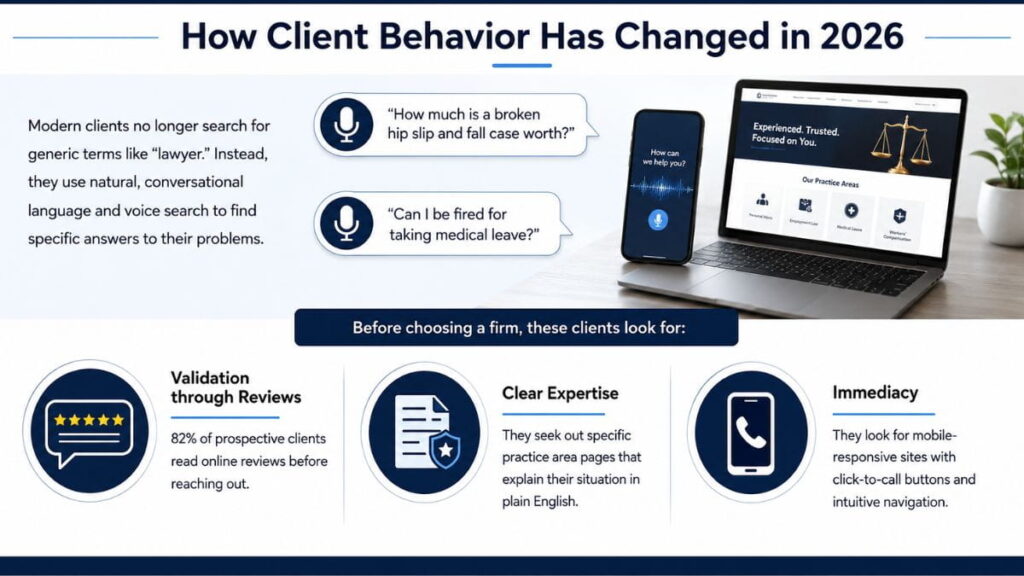
Modern clients no longer search for generic terms like “lawyer.” Instead, they use natural, conversational language and voice search to find specific answers to their problems. They ask questions like, “How much is a broken hip slip and fall case worth?” or “Can I be fired for taking medical leave?”
Before choosing a firm, these clients look for:
Local SEO is the primary battleground for legal instructions because clients want a solicitor they can actually meet. A professional law firm or company will prioritize your Google Business Profile (GBP) as your most impactful asset.
How to build local citations for law firm seo: You must ensure your Name, Address, and Phone number (NAP) are identical across major directories like Avvo, Justia, FindLaw, and the Law Society. Consistency across these citations acts as a powerful trust signal to search engines, boosting your local ranking.
To stop losing leads, you must understand what drives them. How to attribute leads to seo efforts law firm involves using modern tools like Google Analytics 4 (GA4) and Google Search Console to track form submissions and live chat initiations. Furthermore, implementing dedicated call tracking numbers for organic search allows you to attribute inbound calls directly to your SEO investment, ensuring you can calculate a precise ROI.
Building citations involves listing your firm’s consistent Name, Address, and Phone number (NAP) across major legal directories like Avvo, Justia, and FindLaw. Consistency across these platforms acts as a trust signal to search engines, boosting your local Map Pack visibility.
Attribution is achieved by setting up conversion goals in Google Analytics 4 for form submissions and using dedicated call tracking numbers for organic search traffic. This allows you to differentiate between leads from SEO, paid ads, and social media.
Many firms are invisible in the “Local Pack” (the top three map results), which is where most high-intent legal searches end. Additionally, firms often fail to target the specific, long-tail situational questions that high-intent leads actually use.
Clients are now digital-first, using voice search and natural language to find immediate solutions to specific crises rather than searching for generic law firm names. They rely heavily on AI summaries and conversational queries to compare their options.
Clients look for high review ratings (82% read them), clear E-E-A-T signals (Expertise and Authoritativeness), and localized content that proves the firm understands their specific geographic and legal situation.