
The traditional marketing funnel has always looked clean on paper: awareness, consideration, conversion. We imagined a linear path where a user sees a blog, compares two features, and clicks buy.
As we head into 2026, that funnel is no longer a straight line; it has been completely re-engineered. The rise of AI search and LLM-powered engines has introduced a new layer of visibility. Users no longer only search; they consult. They ask ChatGPT to compare your pricing or request that Perplexity find the best enterprise CRM for a mid-scale manufacturer.
If your brand lacks visibility inside these AI-synthesized answers, you are losing the decision before the user even lands on your site.
In modern digital marketing funnel stages, visibility goes beyond ranking first for a keyword. It is now about citation share.
It means your brand must move from being a mere search result to becoming a cited authority. This layer is the synthesized answer space—the AI Overviews and conversational bots that summarize the web for the user. When an AI agent compares three vendors, the decision often forms right there. To be visible there, your content must be structured as data that AI can trust and recommend. How do AI search and LLM-powered engines reshape the decision-making points in the funnel? It depends on your ability to provide clear, entity-based facts that these models can ingest and present as definitive answers.
A robust SEO funnel strategy helps identify where the final decision happens. In 2026, the signal is a micro-query rather than a high-volume keyword. How can SEO help identify the exact funnel stage where users make their final decision? It happens by tracking the transition from broad discovery to specific technical validation.
By looking at the follow-up questions users ask AI assistants—specifically when they shift from broad category questions to technical validation—you can pinpoint the moment of intent.
Once you identify these specific triggers, your content strategy must shift from “educating” to “validating.” If the data reveals users are stalling on integration questions, you must publish specific “validator” assets such as deep-dive API documentation or a dedicated compatibility matrix, rather than generic benefit blogs. This ensures that when an AI model looks for the answer to that specific technical hurdle, your content provides the definitive “Yes,” clearing the path for conversion.
What SEO signals reveal true search intent in 2026? We look for signals like branded comparison searches, deep interaction with pricing calculators, and high scroll depth on technical documentation. These actions indicate that the user is no longer just browsing; they are verifying.
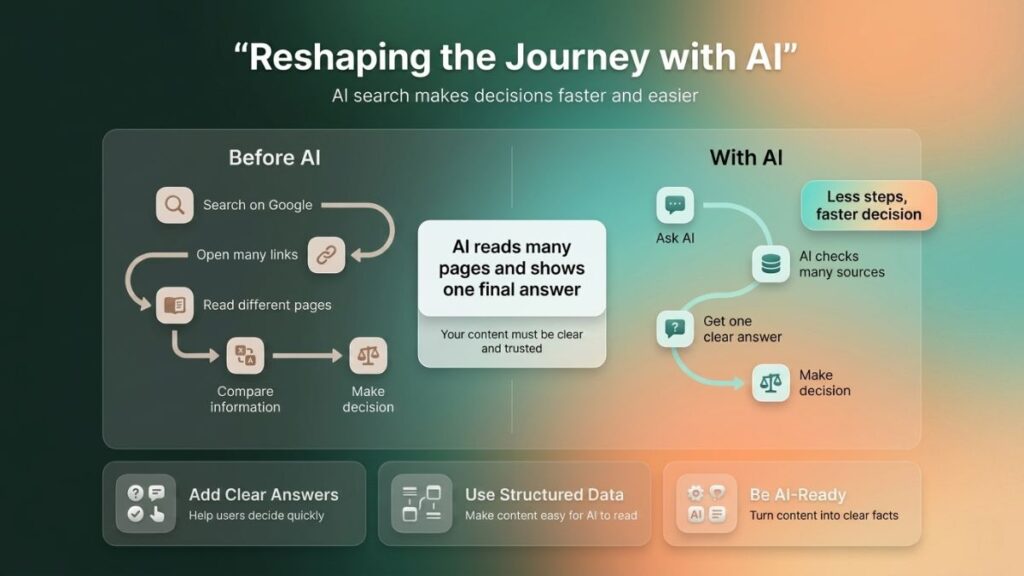
AI search engines shorten the journey. Previously, a user might click five links to find an answer. Now, the AI does the clicking for them and presents the verdict. This means your awareness content must now also contain conversion triggers.
Because AI-first discovery focuses on citation rather than clicks, your content funnel must be technically retrieval-ready. This means using structured data and schema so your technical specs aren’t just text on a page, but facts an LLM can use to recommend you during a comparison.
Understanding marketing funnel stages in 2026 requires a technical bridge between your data and the AI models that now guide your customers.
At Ooptiq, we build business-first architecture. We map your audience’s true decision-making logic and build the technical infrastructure to ensure your brand is the one the AI recommends. From custom dashboards that track your citation share to strategies that leverage every stage of the digital marketing funnel for maximum impact, we make sure you own the new layer of visibility.
Is your current marketing funnel built for 2018 or 2026? Let’s map your audience’s decision journey with a custom audit.