
Most marketers build a content marketing strategy around keywords. Stronger results come from understanding user intent, the purpose behind each search.
The same keyword can represent different needs. A search for content marketing strategy may come from a beginner seeking guidance or a marketer planning a campaign. Addressing both with identical content reduces relevance.
An effective SEO content strategy prioritizes user intent and aligns content with audience needs at every stage of the customer journey.
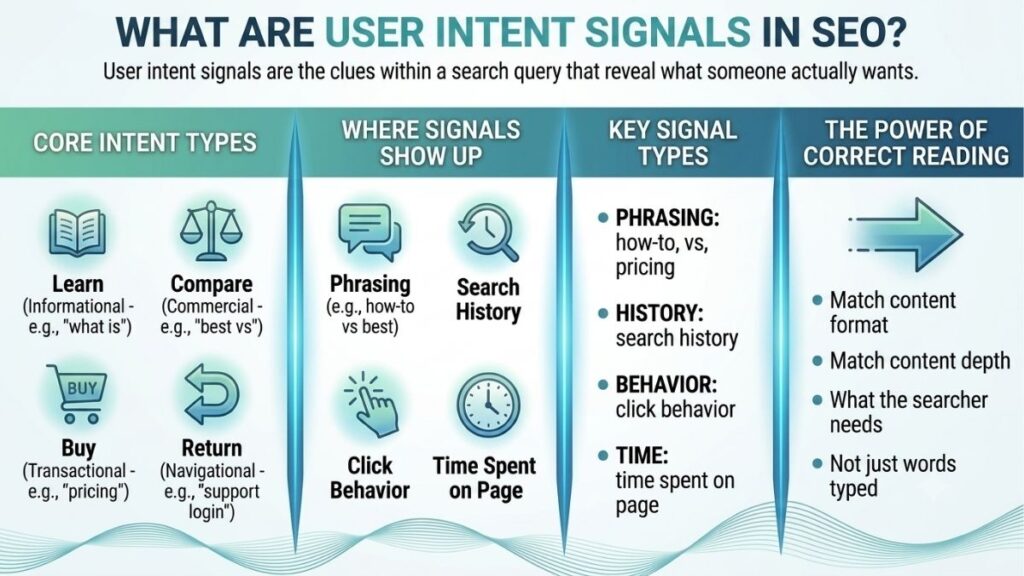
User intent signals are the clues within a search query that reveal what someone actually wants: to learn, compare, buy, or return for support. These signals show up in phrasing (how-to vs. best vs. pricing), search history, click behavior, and time spent on a page. Reading them correctly lets you match content format and depth to what the searcher needs, rather than just the words they typed.
A content strategy built around user intent outperforms one built around keywords alone. The steps below outline a repeatable process for identifying what users want and creating content that meets them at each stage:
Pull recurring questions from Google Search Console, People Also Ask, autocomplete suggestions, sales calls, support queries, and competitor pages. These sources reveal the actual language and concerns of your audience, forming the foundation for every content decision that follows.
Group related queries into sets, including follow-up prompts, to understand how users search across traditional Google results and AI-led search interfaces. This helps you anticipate multi-step research behavior instead of optimizing for a single, isolated keyword.
Sort queries into informational, evaluation, transactional, or retention categories. This classification determines what the user needs from the content, whether it’s education, comparison, a purchase decision, or post-purchase support.
Match each intent category to the right format: blogs and guides for informational queries, comparison pages for evaluation, landing pages for transactional intent, and FAQs, checklists, or tools for retention and quick answers.
Create a comprehensive pillar page around a core topic, then support it with cluster content covering related subtopics in depth. This structure signals expertise and helps search engines understand the full scope of your coverage.
Connect pillar pages, cluster blogs, service pages, and conversion pages through deliberate internal links. Strong linking distributes authority across the site and guides users naturally from awareness content toward conversion-focused pages.
Strengthen content with expert input, real examples, credible sources, visible author credentials, and regularly updated information. These signals help both users and search engines trust the accuracy and authority of your content.
Go beyond generic advice by including original insights, practical frameworks, real examples, decision tables, or actionable takeaways. Content that offers something not easily found elsewhere earns more engagement, shares, and return visits.
Tie every piece of content to a specific goal, such as building awareness, capturing leads, driving conversions, or supporting retention. This ensures content isn’t just published for traffic but contributes to measurable outcomes.
Monitor rankings, click-through rates, engagement, and conversions for each piece. Update content as performance shifts or user intent evolves, treating every page as a living asset rather than a one-time publish.
Consistency matters more than frequency. Publishing two well-researched pieces a month outperforms eight thin posts. Search engines reward topical depth and freshness, so a regular cadence of quality content builds authority faster than sporadic high-volume output.
Start with the problems your customers already voice in sales calls, support tickets, and competitor reviews. Then use keyword tools to validate search volume and match language. Prioritize terms where intent is clear over terms that are simply high-volume. A keyword worth targeting tells you not just what someone searched, but what they were trying to solve.
Content marketing builds topical authority through comprehensive, interconnected content. Rather than relying on a single optimized page, a cluster of related content attracts backlinks, expands keyword coverage, and helps a site rank consistently across more searches over time.
A strong strategy requires ongoing understanding of user intent, mapping content to format, optimizing older content as rankings shift, improving CTR on high-impression pages, and strengthening conversions on pages with high bounce rates.