
Google’s AI Mode is shifting search from links to answers. This changes the goal of AI SEO services from ranking pages to earning visibility inside AI-generated responses. AEO, GEO optimization, and LLMO are essentially different names for the same outcome: becoming a trusted source for AI summaries and zero position ranking. The brands that win will focus on authority, entity clarity, and measurable AI visibility signals.
When we hear “SEO”, we imagine rankings, blue links, and traffic growth from a familiar results page. For years, the goal of SEO was to secure the top spot on the search engine results page. Today, that goal is being radically rewritten. Google’s AI Mode is pushing search into an answers-first experience, where the user often receives a synthesized response before they ever see traditional listings.
This isn’t a minor update. It’s a change in the surface area of search itself. The goal of a modern AI seo strategy is no longer limited to reaching page one. It is increasingly about being cited, summarized, and trusted inside AI-generated answers.
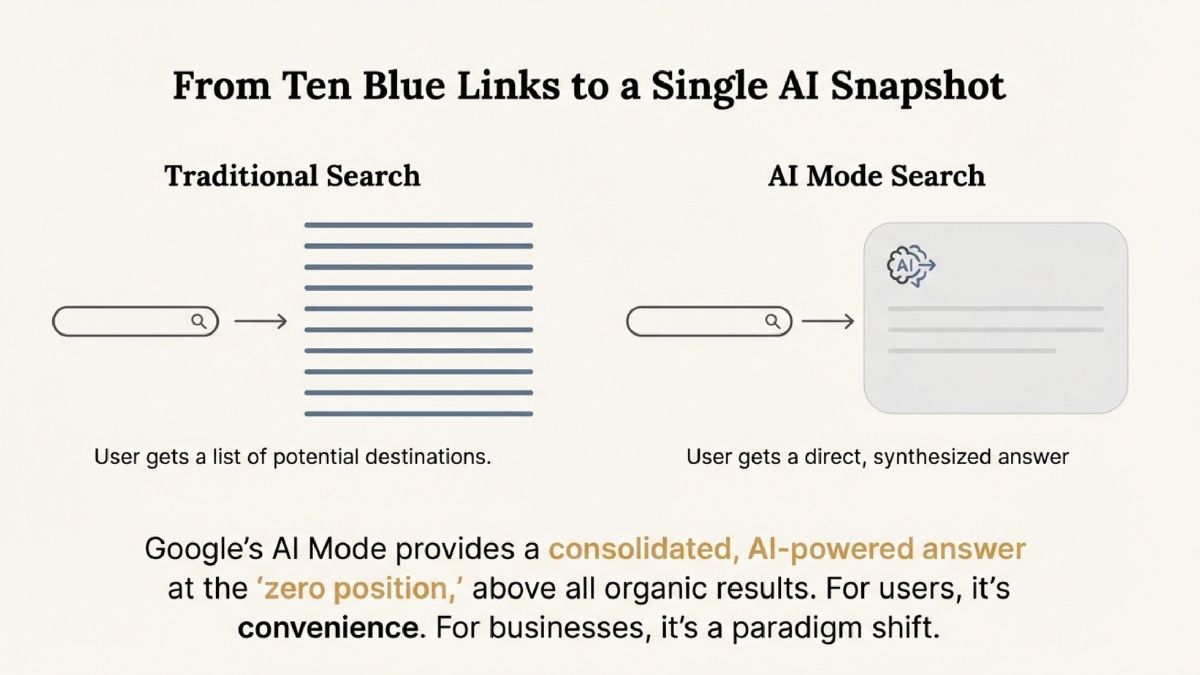
The core of Google’s AI-mode-SEO is its generative snapshot: a consolidated AI-powered answer that sits at the “zero position” above all organic results. For users, it’s convenience. For businesses, it’s a paradigm shift.
This has triggered a shift towards Answer Engine Optimization (AEO) – the practice of optimizing content to be the source for these AI-generated answers. The battle is no longer for click-through rate from position one; it’s for visibility and citation within the AI snapshot itself, a concept now known as zero position ranking.
AI search systems don’t reward keyword density. They reward semantic authority, clarity of intent, and informational usefulness. The following workflow helps your pages align with how AI engines extract, synthesise, and cite content.
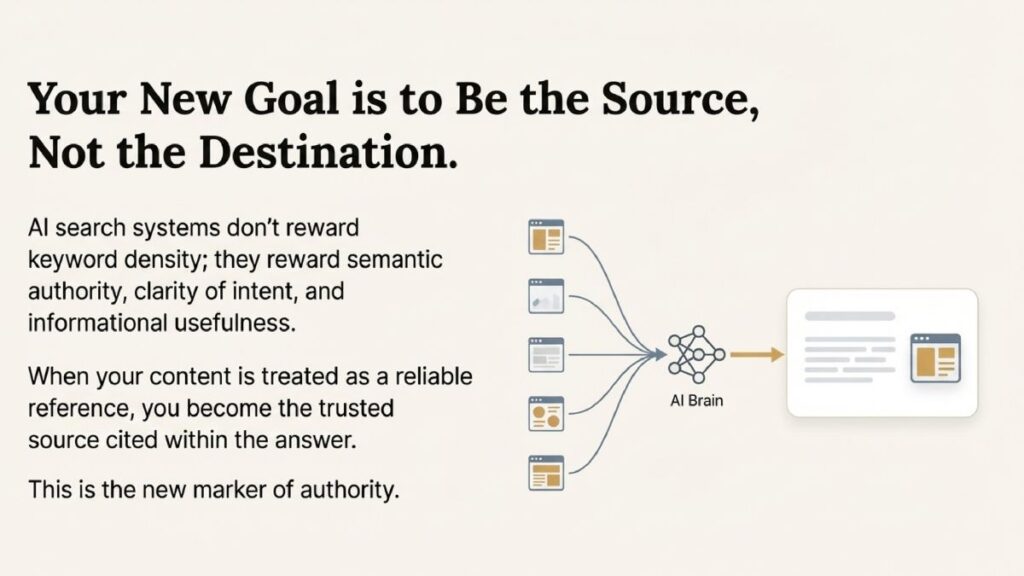
AI models evaluate whether your page can serve as a reliable reference, not whether it repeats a phrase. Build depth around concepts related to the topic so the system sees your content as a stable source in that semantic cluster.
What to focus on:
Pro Tip: Treat every major page as a reference asset; AI engines often cite product, service, or overview pages when they show stronger authority than blogs.
AI models prefer content that is easy to segment, extract, and summarise. Clear hierarchy signals relevance and helps systems pull the right block into an answer.
How to structure:
Pro Tip: A section that reads like a standalone micro-guide increases the likelihood of being quoted.
To produce an authoritative answer, AI cross-checks multiple concepts within your page. Broader semantic coverage increases confidence in your content.
What to include:
Pro Tip: Think in clusters; a strong cluster signals mastery better than a single long page.
AI systems identify certain structures like definitions, steps, comparisons, FAQs as “high-utility” blocks.
Add formats such as:
Pro Tip: Keep answers under 40–50 words when you want a block eligible for direct quotation.
Schema markup and internal linking help search systems interpret relationships between concepts across your site.
Implementation focus:
Pro Tip: Schema doesn’t guarantee citations, but absence of schema often removes a page from the candidate pool entirely.
The metrics that matter are changing. Impressions and clicks may decline, but visibility in the AI snapshot, the new zero position ranking, becomes the primary KPI. Brands that adapt will enjoy unprecedented authority. Those that don’t will become invisible.
The businesses that will thrive are those that stop optimizing for a search engine and start optimizing for an answer engine.
Traditional search returns a list of links. Google’s AI Mode generates a single, conversational answer by synthesizing information from high-quality sources, fundamentally changing how users find information.
Yes. As AI provides direct answers, many queries will be satisfied within the results page, making visibility in the AI snapshot (zero position ranking) more critical than the #1 organic link.
By doubling down on GEO optimization and creating deep, question-answering content that addresses local problems. This makes them a prime source for AI to recommend in response to hyperlocal, service-based queries.
Ready to adapt your strategy? An AI driven SEO agency like OOPTIQ can help you build a presence where it matters most—in the AI snapshot.