
TL;DR: Content marketing isn’t a department anymore, it’s the operating system for every customer interaction. Landing pages, ads, sales decks, even error messages are all content doing marketing’s job. In 2026, the businesses winning aren’t producing more content, they’re producing content backed by real expertise, original insight, and a distinct voice, because that’s the only kind AI can’t fake and audiences can still trust.
Many marketers still associate content marketing primarily with blogs, newsletters, and social media posts. In 2026, that view is increasingly outdated.
Content is no longer just another marketing channel, it is the foundation of modern marketing. Landing pages, advertisements, sales presentations, product descriptions, email campaigns, and even website error messages all rely on content to communicate value and shape customer experience. The explosion of digital content marketing has not just created more things to write, it has redefined marketing practices itself.
Content marketing used to be defined by format. For example, blog posts that rank, social content that engages, email newsletters that nurture. That definition is now obsolete.
A more accurate definition for 2026 can be that content marketing is the practice of using structured, intentional messaging to attract, educate, and convert audiences, regardless of format, channel, or funnel stage.
Here are two things that happened at once:
First, AI tools collapsed the cost of producing content, flooding every channel with an unprecedented volume of words, images, and video.
Second, buyers changed how they make decisions. They research independently, consult AI assistants, watch short-form video, and arrive at a purchase decision before they ever speak to a salesperson.
Content marketing is important because it supports virtually every marketing function. Without it, the customer journey becomes fragmented and ineffective.
Consider the buying journey. A potential customer searches a question in an AI assistant and gets an answer that cites a source. They click through, land on a well-written homepage, download a lead magnet that solves a real problem, receive an email sequence that builds trust over two weeks, and eventually book a call. Remove the content at any point and the journey breaks.
As a result, content marketing is no longer confined to a single department or campaign. It drives brand awareness, lead generation, search engine optimisation, customer education, and product discovery. For businesses seeking sustainable growth in 2026, content is not simply a marketing asset. It is a core business function.
Landing pages are among the most direct applications of content marketing. Their effectiveness depends on headlines, value propositions, benefit statements, social proof, and calls to action. Strong copy improves conversions, while weak messaging reduces the return on every marketing dollar spent driving traffic.
Modern lead generation relies on valuable content offered in exchange for contact information. Checklists, research reports, audits, and educational resources help businesses attract and qualify prospects. The quality of these assets directly influences engagement, sharing, and conversion. As privacy regulations evolve and third-party data becomes less accessible, content-driven lead magnets have become increasingly important for audience building.
Email marketing remains one of the most effective content channels for building customer relationships. Welcome emails introduce the brand, nurture sequences educate prospects, and promotional emails drive action. Consistent, relevant, and valuable content strengthens trust over time, while generic messaging often leads to disengagement.
Sales materials are also content assets. Presentations, proposals, and case studies communicate value, address objections, and reinforce brand positioning. When sales content aligns with broader marketing messaging, it creates a consistent customer experience and strengthens credibility throughout the buying process.
User experience content plays a critical role in guiding customer actions. Navigation labels, onboarding messages, button text, and product descriptions influence how users interact with a website. Clear and informative copy improves usability, reduces friction, and supports conversion. Effective product descriptions go beyond features by addressing customer needs and purchase concerns.
Paid advertising depends heavily on content quality. Search ads, display campaigns, sponsored posts, and video advertisements all require concise and persuasive messaging. Successful campaigns combine audience understanding with clear value communication, ensuring that advertising functions as part of a broader and consistent content strategy.
Search engine optimization runs entirely on content, from pillar pages and blog articles to the structured data that helps search engines and AI systems understand what a page covers. As AI Overviews and generative search reshape visibility, content built for SEO must also be built to be cited. A well-organized, authoritative, and specific content can stand on its own inside an AI-generated answer.
Social platforms function as both a discovery channel and a trust-building layer, where short-form video, posts, and community engagement shape how audiences perceive a brand. Effective social content reflects the same voice and expertise as the rest of a brand’s content, rather than existing as a separate, disconnected workstream, so that awareness generated on social media carries through to conversion elsewhere.
Search engine optimization and content marketing have been inseparable for years, but the relationship deepened further in 2026 as AI Overviews and generative search results reshaped how visibility works.
The traditional benefit of content that ranks brings organic traffic, still holds. But in 2026, content that is well-structured, authoritative, and cited earns mentions inside AI-generated answers. This zero-click visibility, where a brand appears in the AI summary before any link is clicked, is now a core SEO goal. It requires the same inputs as traditional content marketing, but rewards those who treat content as genuine intellectual property rather than keyword-stuffed filler.
The brands building the most durable SEO advantages in 2026 are those publishing proprietary research, expert perspectives that AI cannot synthesize from existing sources, and structured content that answers not just one question but the cluster of related questions around it.
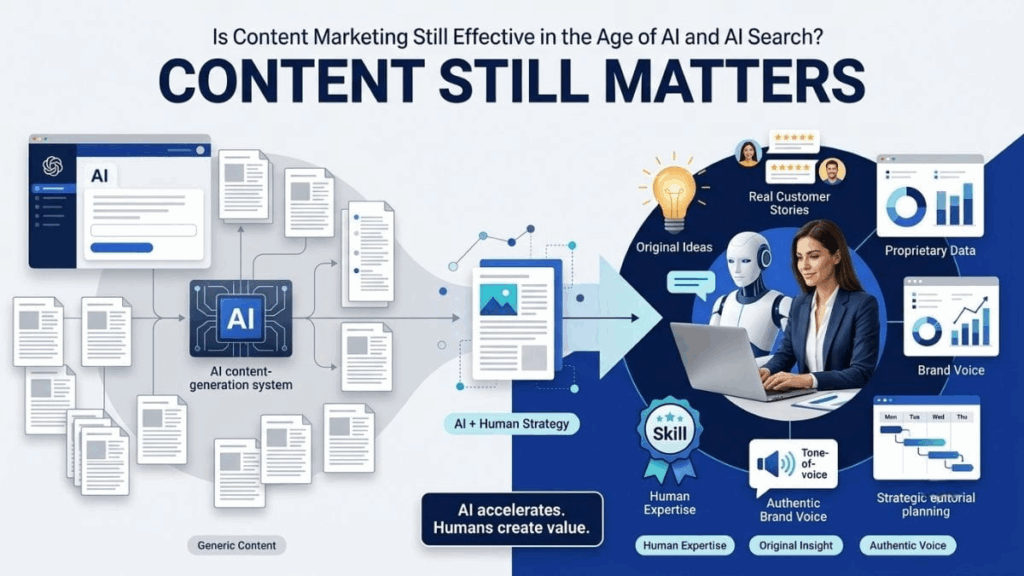
The concern is understandable. If AI can produce unlimited content, doesn’t that make content a commodity? The evidence says no — but it does change what makes content valuable.
Generic content is indeed a commodity now. A 1,000-word overview of a well-documented topic, written without original insight or genuine expertise, is worth roughly nothing in 2026. But content built on original perspective, real customer stories, proprietary data, or a distinctive voice is more valuable than ever — precisely because it is rarer. Consumer trust in AI-generated content has dropped sharply. Authenticity has become a competitive moat.
The effective use of AI is not to replace content marketing thinking with generated text. It is to use AI to accelerate the production of content that a skilled human has strategically planned, editorially shaped, and authentically voiced.
This is the question every business asks, and the honest answer is, it depends on the content type.
Ad copy and landing page copy can show conversion impact within days of a change. Email sequences show engagement results within the first send cycle. Organic content like blog articles, pillar pages, thought leadership, typically takes three to six months to build ranking authority and another three to six months to compound into meaningful traffic. The compounding nature of content is also its greatest strength. A well-written article published today can generate leads two years from now without additional spend.
Content is no longer something your marketing team produces alongside other marketing work. Every function that involves communicating with a potential customer, from the first AI search result they encounter to the proposal they sign, depends on content that is clear, credible, and strategically built. The businesses that understand this are not asking whether to invest in content marketing. They are asking how to make sure every word, in every format, across every channel, is doing its job.