
Cross-platform development has shifted from being a cost-saving option to a strategic decision. Businesses want faster releases, consistent user experience, and maintainable code across platforms. The question is no longer whether to adopt cross platform development, but which approach delivers the right balance between performance, flexibility, and long-term scalability.
Two leading approaches today are Kotlin multiplatform and Flutter app development. Both aim to reduce duplication in mobile app development and web app development, but they follow very different philosophies.
Kotlin multiplatform allows developers to share business logic across platforms while keeping native UI layers. Instead of writing separate codebases for Android and iOS, teams write shared modules for core functionality such as networking, data handling, and domain logic.
The UI remains platform-specific:
This approach works well when teams want:
Kotlin multiplatform is not a full UI framework. It is a way to share logic while preserving native experiences.
Flutter app development follows a different model. It is a complete open source framework developed by Google that allows developers to build UI and logic in a single codebase using Dart.
Flutter renders its own UI using a custom engine rather than relying on native UI components. This enables:
Flutter is widely used for:
It acts as both a UI toolkit and application framework.
The main difference between Kotlin multiplatform and Flutter lies in how they handle code sharing.
This difference impacts development workflow, performance, and user experience.
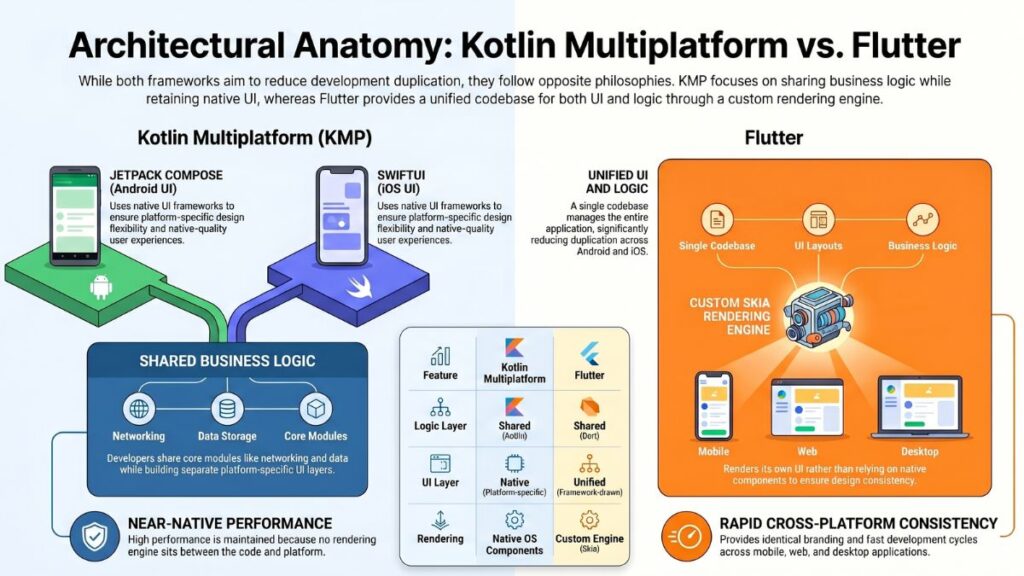
Kotlin multiplatform typically delivers near-native performance because:
Flutter performs well for most use cases but introduces an abstraction layer:
In real-world applications:
Flutter uses a single codebase for both UI and logic. This reduces development effort and ensures consistency across platforms.
Kotlin multiplatform shares only core logic. UI must still be written separately for each platform.
This leads to a trade-off:
Flutter is a strong choice when:
It works well for startups and products that need rapid iteration and consistent branding.
Kotlin multiplatform is better suited when:
It fits well for enterprise applications where platform-specific behavior matters.
Flutter extends beyond mobile and supports web app development through its framework. It allows teams to reuse code across mobile and web environments.
Kotlin multiplatform also supports web through Kotlin/JS, but its ecosystem is less mature compared to Flutter’s integrated approach.
For businesses targeting multiple platforms with a single design system, Flutter often provides a more unified solution.
Flutter benefits from:
Kotlin multiplatform benefits from:
Both are part of modern cross platform development, but their ecosystems serve different needs.
The choice depends on priorities rather than features alone. Below is a comparison of the suitability of both the frameworks:
There is no universal winner. The decision should align with product goals, team expertise, and long-term scalability.
Cross platform development is no longer about compromise. Both Kotlin multiplatform and Flutter app development offer strong solutions, but they solve different problems.
Flutter simplifies development by unifying UI and logic. Kotlin multiplatform preserves native control while reducing duplication in core logic.
Understanding these differences helps teams choose a framework that fits their product strategy rather than forcing a one-size-fits-all approach.
Kotlin multiplatform offers near-native performance because it uses native UI, while Flutter performs well but relies on its own rendering engine.
Flutter uses a single codebase for both UI and logic. Kotlin multiplatform shares only business logic while UI remains platform-specific.
Flutter is ideal when fast development, consistent UI, and a single codebase are priorities.
Kotlin multiplatform shares logic and keeps native UI, while Flutter controls both UI and logic within its own framework.