
| TL;DR: To succeed in the evolving Google AI experience, brands must transition from keyword density to intent-based authority. By combining technical requirements for Google Search with high-quality, structured content, you can ensure your site is recognized as a primary source for AI-generated answers. |
The way we interact with information is shifting as the Google AI experience becomes the new standard for discovery. We are moving away from a world of simple links toward AI Search Results that synthesize complex answers in real-time. For content creators and businesses, this means the bar for quality has been raised; you are no longer just competing for a click, but for a citation within a Google AI Mode response.
At Ooptiq, we prioritize business-first architecture to help you navigate these shifts. Achieving AI visibility requires a strategy that treats your content as a structured data source for LLMs while maintaining a seamless journey for human readers.
Structured data markup acts as a technical translator for Google’s algorithms. By implementing specific schema hints—such as FAQ, How-To, or Product types—you help AI systems grasp the structure of your information instantly. This technical clarity makes it significantly easier for an AI Search Result to parse your content and include it in AI Overview summaries. Beyond mere text, this markup allows search systems to understand the relationships between different entities on your page.
Traditional practices remain the foundation, but their application has evolved. While you still need to meet the technical requirements for Google Search, the focus has shifted from simple link-building to becoming the most trustworthy and complete answer on a topic. Modern search systems fanned out across trusted sources prioritize lived expertise over shallow coverage. E-E-A-T (Experience, Expertise, Authoritativeness, and Trustworthiness) is now enforced at scale, meaning that original insights and transparent authorship are no longer optional for those seeking citations.
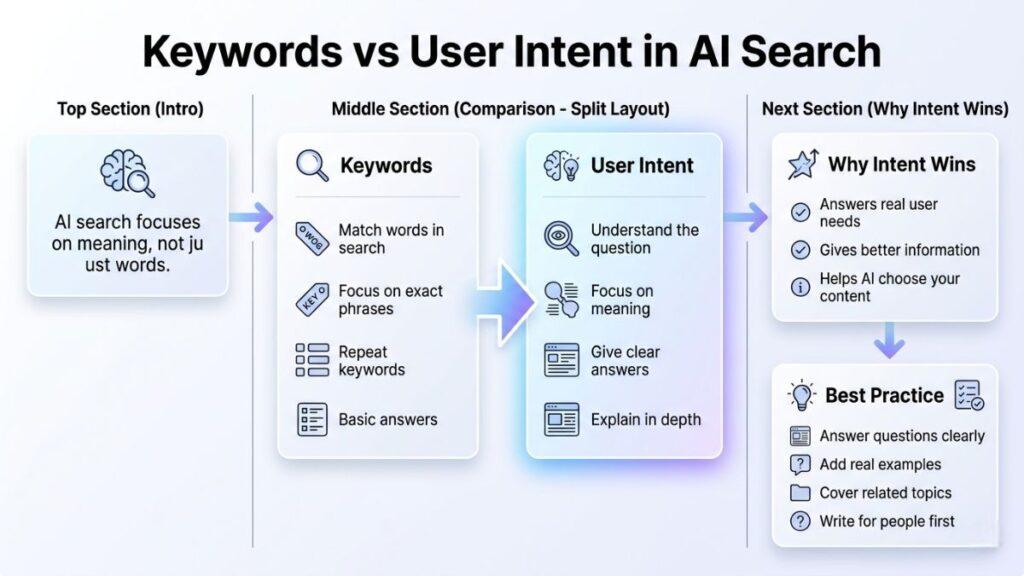
The modern landscape focuses on understanding the intent behind queries rather than matching specific keywords. While keywords help signal relevance, AI systems prioritize how well you actually answer the user’s question. To outperform existing content, you should focus on tighter alignment with search intent and clearer explanations. Instead of repeating broad phrases, add depth with real-world context and subtopics that existing pages might have missed.
Page experience and site performance are critical because they signal the reliability of a source. In an AI-first ecosystem, readers and algorithms care about well-structured, meaningful answers that are easy to access. High-quality content must be paired with a technical structure that allows for instant parsing. If your site performance is lagging, AI assistants are less likely to cite you as a primary source because the user journey is compromised.
Absolutely. We are entering the era of multimodal search, where Google processes information across text, images, and video simultaneously. Providing layered ideas through visuals, such as comparison charts or timelines, makes your content more useful for both humans and AI. Including multimedia allows your brand to appear in diverse search formats beyond traditional text, capturing attention in specialized AI-driven carousels and visual snippets.
Success in the age of the Google AI experience is about more than just words on a page; it is about raising the quality bar of your entire digital ecosystem. At Ooptiq, we bridge the gap between engineering and growth by helping you create the most citable version of your expertise.
Ready to claim your place in the future of search? Let’s audit your content’s semantic structure and ensure your brand is ready for the next generation of AI Search.