
AI agents are shifting search from a human-driven activity to an automated decision process. As autonomous AI agents increasingly handle discovery, comparison, and shortlisting on behalf of users, traditional search traffic will decline sharply. Businesses must adapt by optimizing for agent-led search, restructuring content for machine decision-making, and measuring influence beyond clicks.
Search has always been a human activity. A person types a query, scans results, clicks links, reads content, and eventually decides. That model is now breaking.
Autonomous AI agents which are systems programmed to execute tasks, make comparisons, and deliver decisions are beginning to take over the discovery phase entirely. Instead of users searching, they delegate the task to an agent. Instead of users searching, comparing, and filtering information themselves, they are delegating those tasks to agentic AI systems trained to act on their preferences. These agents search, summarize, eliminate options, and surface recommendations—often without the user ever seeing a traditional search results page.
This shift is not theoretical. As agent-led search becomes embedded across operating systems, browsers, ecommerce software, and productivity tools, businesses should expect a structural decline in human-initiated search traffic. The implication is clear: search traffic is no longer guaranteed, even if demand still exists.
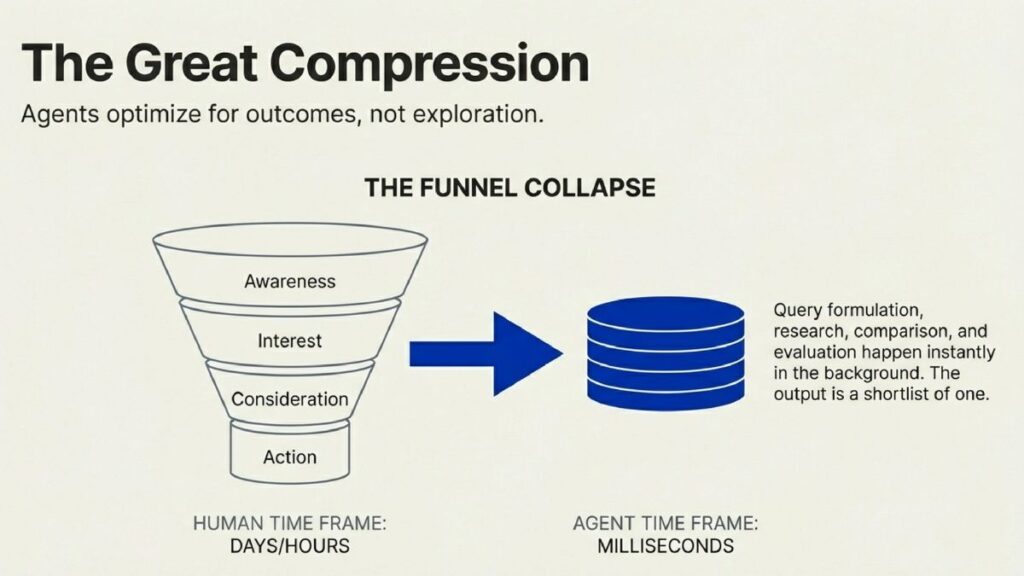
AI agents are designed to optimize outcomes, not exploration. Unlike users, they don’t browse. They execute.
Agent-led search works by compressing multiple steps—query formulation, research, comparison, and evaluation—into a single automated workflow. A user might instruct an agent to “find the best enterprise CRM for a distributed sales team” or “compare ecommerce platforms for B2B growth.” The agent handles the rest.
This fundamentally changes online search behavior. Instead of hundreds of impressions and dozens of clicks, the process may result in a shortlist of one or two recommendations. Brands that are not surfaced by the agent simply disappear from the decision set.
The result is a sharp decline in traditional search traffic, even as purchasing intent remains high.
AI agents don’t search like humans—and they don’t behave like search engines.
Where humans scan titles and snippets, agents parse meaning. Where humans tolerate ambiguity, agents eliminate it. Where humans explore multiple sources, agents consolidate and filter aggressively.
This leads to three major behavioral shifts:
In effect, agents become the new gatekeepers of discovery.
Blogs were designed for education and discovery. In an agent-led environment, that role weakens. Agents rarely cite long narrative content unless it contains definitive explanations or structured answers.
This doesn’t mean blogs are obsolete—but their function changes. Instead of driving traffic, blogs increasingly serve as training material for agents and language models, contributing to brand understanding rather than direct conversion.
Agentic AI systems rely heavily on pages that clearly explain what a product is, who it is for, how it works, and where it fits. Ambiguous marketing language becomes a liability.
In agent-led search, product and solution pages are often treated as primary sources. They must be explicit, structured, and decision-ready.
AI agents prioritize clarity and reliability over brand fame. A smaller company with precise, well-structured content can outperform a market leader with vague messaging.
Influence shifts from “who ranks highest” to “who explains best.”
Before tactics, one reality must be accepted: optimizing for AI agents is not a subset of SEO. It is a parallel discipline that overlaps with SEO but serves a different decision-maker—the machine.
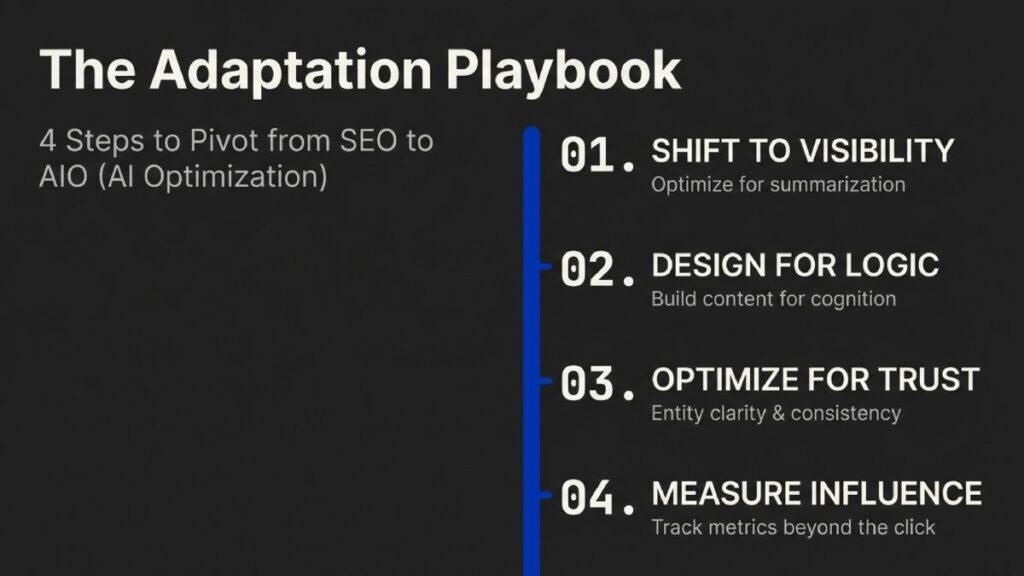
The first adjustment is strategic. Success is no longer measured in clicks, but in being selected as a source by autonomous AI agents.
What this involves:
Pro Tip:
If an agent can’t cleanly summarize your page into a recommendation, it will be ignored.
Agents extract signals to reason. Your content must be built to support this machine cognition.
What agent-first content includes:
This allows agents to eliminate uncertainty and confidently recommend a brand.
Pro Tip:
Ambiguity slows agents down. Clarity accelerates selection.
AI agents don’t rank pages; they choose reliable sources. Optimization must build machine trust.
Key adjustments:
Pro Tip:
For agents, consistent signals across the web build more trust than a single clever tagline.
AI agents replacing search will lead to measurable declines in organic traffic. This is not a failure—it is a signal of behavioral change.
Businesses must adapt their analytics accordingly:
Pro Tip:
When traffic declines, track upstream metrics: brand mentions in agent outputs and inclusion in sourced shortlists.
Not all content is equally useful to AI agents. Certain formats consistently outperform others:
Long, narrative storytelling is less effective unless paired with extractable insights.
The future of search with AI is not about replacing Google with another interface. It is about replacing human effort with autonomous decision systems.
As agentic AI becomes more capable, users will trust agents to handle more of the funnel—from discovery to evaluation to execution. Businesses that fail to adapt will see shrinking visibility, even if their offerings remain competitive.
Those that succeed will not chase traffic. They will shape the answers agents deliver.
AI agents will reduce manual searching by handling discovery, comparison, and filtering automatically, leading to fewer clicks and faster decisions.
Search engines return options for humans to evaluate. AI agents evaluate options themselves and return decisions or shortlists.
Traditional SEO focused on rankings and traffic. AI agents SEO focuses on clarity, structure, and inclusion in agent decision workflows.
By restructuring content for machine readability, clarifying positioning, and measuring influence beyond clicks.
It is the practice of designing content to support AI reasoning, comparison, and selection rather than human browsing.
Yes. As autonomous AI agents become mainstream, human-initiated search traffic will decline, even as purchasing intent remains strong.