
Google AI Mode is accelerating the shift toward zero-click search, fundamentally altering how leads are discovered, evaluated, and attributed. As AI-generated answers increasingly replace traditional result pages, click-based attribution is collapsing. In 2025, enterprise lead generation will depend less on blog traffic and more on visibility inside AI Mode answers—driven by adapter pages, structured data, and conversation-first content. Winning brands will redesign their SEO and funnel strategies around AI visibility, not clicks.
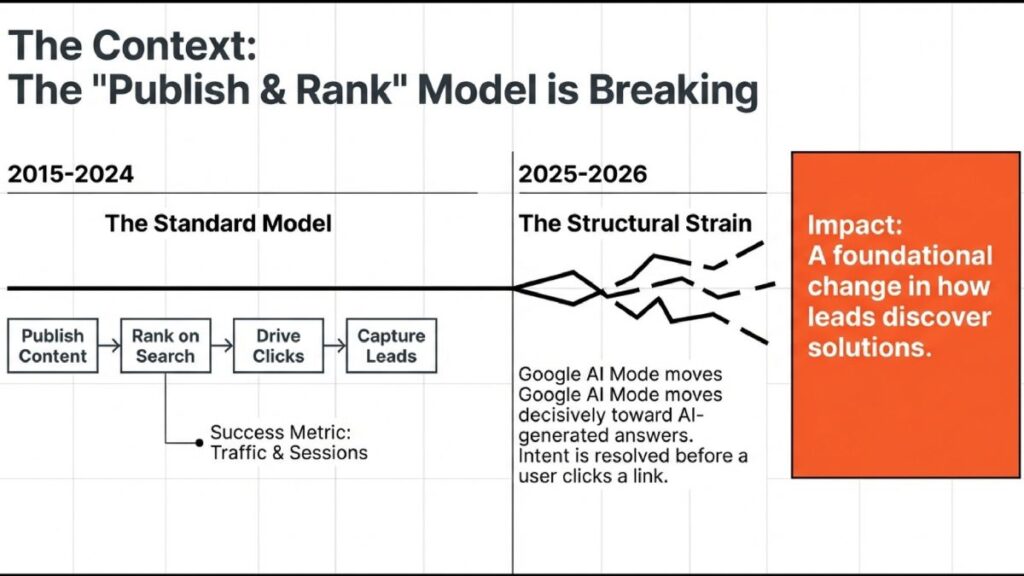
For more than a decade, digital lead generation followed a familiar pattern. Publish content, rank on search, drive clicks, capture leads, and measure success through attribution models built on traffic. That model is now under strain. With the rollout of Google AI Mode by Google, search is moving decisively toward AI-generated answers that resolve intent before a user ever clicks a link.
This shift is not incremental, but rather a structural change in how users discover solutions, how trust is established, and how leads are generated, especially for enterprises operating in complex, high-consideration markets. In 2026, AI lead generation will look very different from what most SEO and marketing teams are prepared for today.
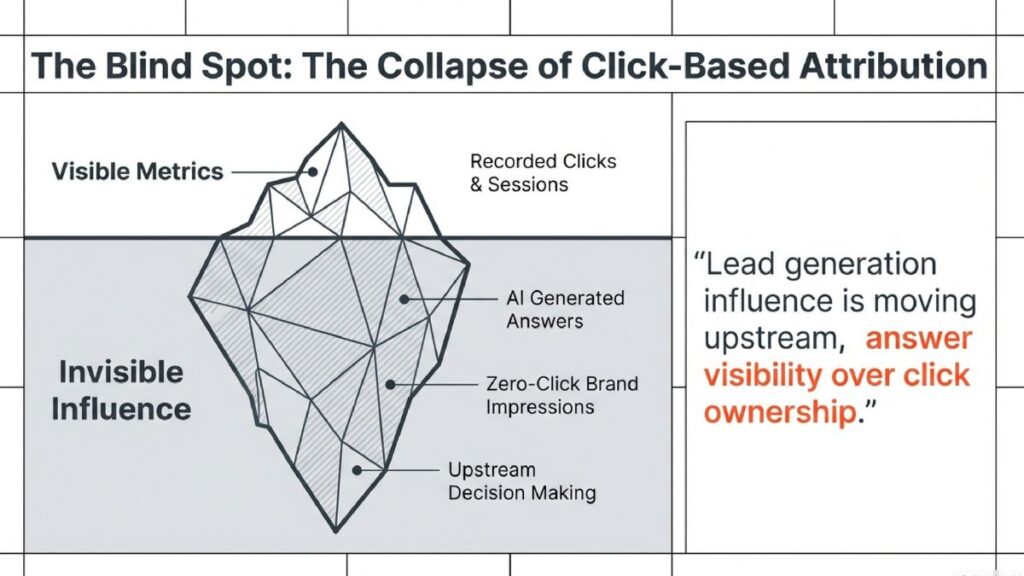
Click-based attribution works on the assumption that users go through discovery, evaluation, and conversion one step at a time. A user searches, clicks a page, consumes content, and then converts. Google AI Mode breaks this sequence.
In AI Mode, users increasingly receive synthesized answers directly within search. These answers combine insights from multiple sources and often provide enough clarity to satisfy intent without further exploration. The content still shows up often, but far fewer people actually click on it.
This creates a measurement problem. Traditional analytics may show falling traffic even as brand influence increases. Enterprise teams that continue to evaluate SEO performance purely through clicks and sessions risk misreading success as failure.
The real shift:
Lead generation influence is moving upstream, prioritising answer visibility over click ownership.
The rise of AI Overviews doesn’t just change how users search; it changes when and where decisions are formed in the customer journey.
In classic SEO, discovery and decision-making were distributed across multiple stages. Blogs played an educational role, solution pages handled comparison and conversion, and retargeting addressed uncertainty. Users moved gradually from awareness to intent through several touchpoints.
Google AI Mode collapses this extended process. Instead of navigating across pages, users are presented with synthesized responses that combine context, options, and implications in a single view. The journey becomes shorter, faster, and more front-loaded.
This compression is achieved because AI Overviews act as an early-filter mechanism at the very start of the journey. Users ask complex, conversational questions and receive structured answers outlining trade-offs and next steps. By the time a click happens—or doesn’t—their preferences are often already formed.
For enterprise lead generation AI strategies, influence moves upstream. The brand surfaced inside the AI-generated answer gains disproportionate credibility, even if the user never visits the website.
One of the most misunderstood impacts of AI Mode SEO is its effect on content types. Blogs are not disappearing, but their role is changing.
Blogs remain useful for depth, topical authority, and long-tail discovery. However, AI systems increasingly prioritize pages that provide definitive, reference-style information when constructing answers. Product, solution, and category pages are becoming primary sources for AI summaries.
In zero-click search lead generation environments, these pages often outperform blogs because they answer “what should I choose?” rather than “what is this?”
Implication for enterprises:
If your most authoritative explanations live only in blogs, you may be invisible where decisions are actually made.
Adapting to Google AI Mode requires more than tactical SEO adjustments. It demands a deliberate rethinking of how enterprise lead generation is designed, measured, and optimized in an AI-mediated search environment. The following steps outline how enterprises can realign their strategies to remain visible, influential, and conversion-ready in 2025.
The first adjustment is conceptual. Enterprise SEO teams must stop optimizing solely for rankings and clicks and start optimizing for presence inside AI Mode answers.
What this involves:
Pro Tip:
In AI Mode, being the clearest explainer often matters more than being the most creative marketer.
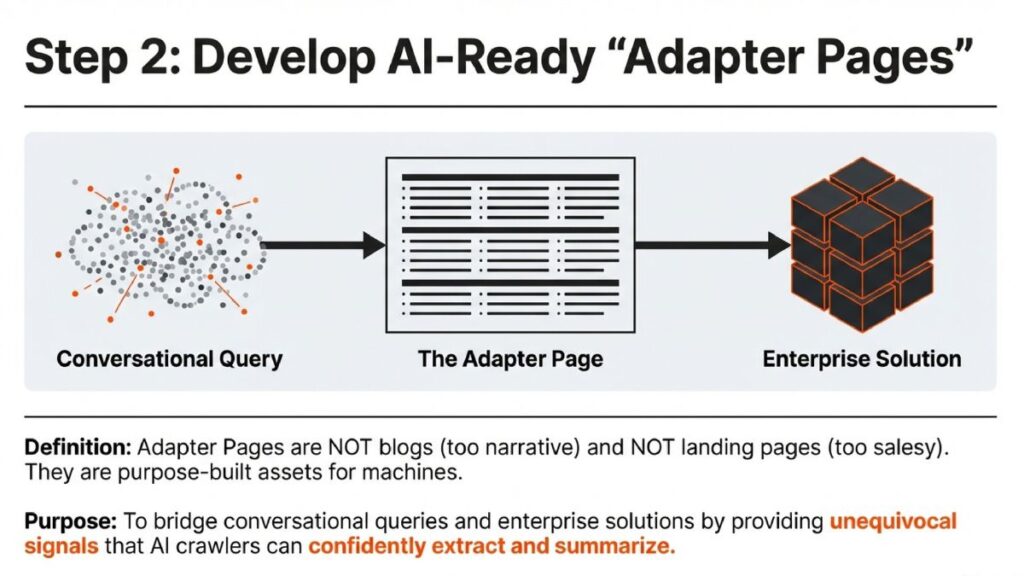
AI crawlers rely on content they can confidently extract, compare, and summarize. AI-Ready Reference Pages are purpose-built assets that bridge conversational queries and enterprise solutions. Unlike traditional blog posts (which educate) or generic landing pages (which convert), these reference pages help AI systems make unequivocal decisions about recommending or citing a brand or solution.
Answer engines prioritize pages with explicit structure and clear decision logic. When a user’s prompt is tasked with “find the best platform for B2B ecommerce,” the crawler bots evaluate whether a page contains clearly articulated criteria and conclusions. That’s the space AI-Ready Reference Pages are built for.
These elements give AI systems confidence when deciding whether to reference, summarize, or recommend a page inside overviews—especially in agent-mediated search outputs where uncertainty weakens citation likelihood.
Pro Tip:
In AI-first discovery, clarity and direct answerability often outperform high-traffic blogs because AI crawlers seek unequivocal signals and not exploratory narratives.
AI Mode SEO depends heavily on machine-readable clarity. Structured data helps AI systems understand what a page represents, how it relates to other entities, and when it should be surfaced.
Key focus areas:
Pro Tip:
Structured data doesn’t guarantee inclusion, but its absence often disqualifies pages from AI consideration.
AI-driven lead generation in 2025 will not follow linear funnels. Users may encounter your brand multiple times inside AI summaries before ever visiting your site—or converting through a direct inquiry.
This requires rethinking funnels as influence systems rather than traffic pipelines.
What to optimize:
Pro Tip:
Zero-click does not mean zero impact. It means attribution must move beyond last-click logic.
For many enterprises, the answer is yes, but only if it’s understood correctly. It doesn’t replace sales teams or traditional channels; it reshapes how prospects first engage.
AI search impact on leads is most visible at the top and middle of the funnel, where awareness, qualification, and trust are formed. Enterprises that ignore this layer may still capture leads, but they will lose influence earlier in the journey.
Enterprise SEO strategy in 2026 will be defined by adaptability. Teams must accept that conversational search will continue to reduce visible clicks while increasing invisible influence.
Success will depend on:
The future of AI lead generation 2026 is not about chasing algorithms. It is about designing for how AI mediates human decision-making.
They influence discovery and evaluation by appearing inside AI-generated answers, shaping decisions before users reach a website.
Yes, especially for enterprises, as it impacts early-stage trust and qualification in high-consideration journeys.
Yes. It shifts SEO from traffic acquisition to visibility and authority inside AI-mediated answers.
They are non-linear systems where AI summaries, brand mentions, and delayed conversions play a central role.
By prioritizing AI Mode optimization, structured data, adapter pages, and measurement models beyond clicks.