
Imagine spending years optimizing your brand for Google’s secret algorithm, chasing keywords, and building backlinks, only to find the goalposts have shifted overnight. The arrival of AI search engines like Google’s SGE and the rise of conversational queries in ChatGPT have laid bare many traditional SEO tactics to be obsolete. The crucial element that you must keep in mind is this: you are now optimizing for a rational engine, not a mere database.
Thus, simply creating more content is not enough. The real competitive advantage comes from mastering a new discipline: AI SEO optimization. This strategic shift moves beyond keyword matching to building topical authority and semantic understanding. This article explores how integrating semantic SEO principles with LLM optimization transforms your content into a preferred source for AI, building a moat that competitors cannot easily cross.
For decades, traditional SEO revolved around keywords and backlinks. This formed the core signals that helped search engines interpret intent. That foundation hasn’t disappeared; in fact, keywords remain the backbone of organic search. What has changed is how those keywords are processed. AI-driven search now interprets them through layers of topical authority, semantic relationships, and long-tail variations. A younger SEO professional might find this surprising, and not because the old model is gone, because the way it is applied has expanded dramatically in the AI-search era.

The rise of Large Language Models (LLMs) in search, from Google’s Search Generative Experience (SGE) to direct queries in ChatGPT, has fundamentally changed how users find information. They no longer type fragmented keywords; they ask full-sentence, conversational questions.
Traditional SEO optimized for a database. AI SEO optimization optimizes for a reasoning engine. The former is about matching keywords; the latter is about demonstrating subject-matter authority.
This is the core of AI search engine optimization. It’s a strategy focused on creating content that is not just found by LLMs, but is valued and used by them to generate comprehensive, authoritative answers.
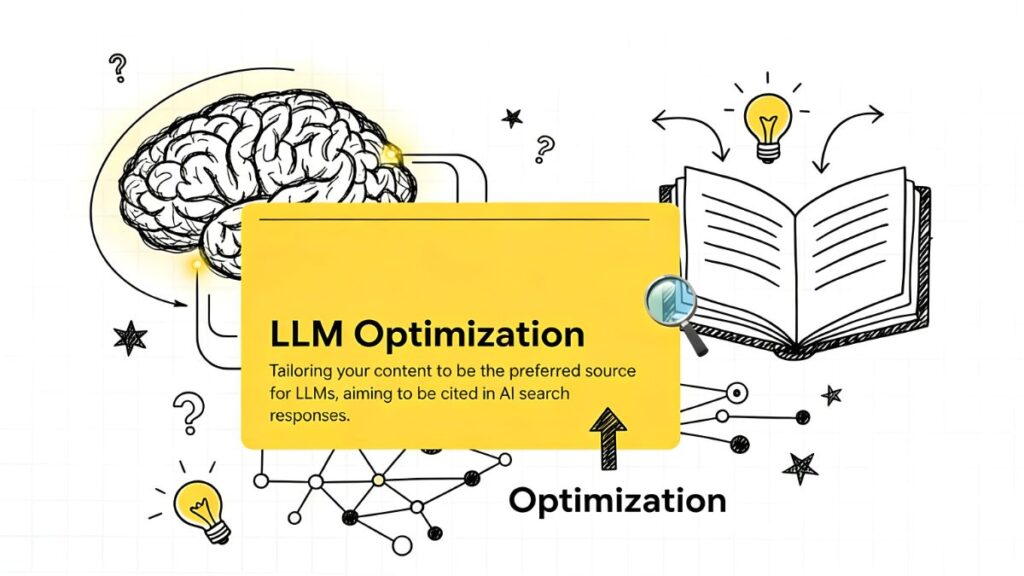
LLM optimization is the specific practice of tailoring your content to be the preferred source for Large Language Models powering AI search interfaces. The goal is to have your content cited as a source in Google’s AI mode or AI overviews, or to be the primary reference in a ChatGPT response.
How it Works: LLMs are trained on massive datasets of text and code. Furthermore, they learn patterns, relationships, and the contextual meaning of information. When they generate an answer, they don’t just “link” to a source; they synthesize information from what they deem the most trustworthy and comprehensive sources.
Pro Tip: To rise up in LLM optimization, stop writing for a “reader” and start writing for a “researcher.” It’s a rational engine now. Your content must be the most well-structured, factually accurate, and comprehensive resource on a given topic.
An effective AI content optimization strategy for LLMs focuses on:
To outperform competitors, your AI SEO strategy must be built on three non-negotiable pillars.
Forget single-keyword pages. Semantic SEO involves creating comprehensive content hubs that cover every facet of a core topic. This means:
Experience, Expertise, Authoritativeness, and Trustworthiness are more critical than ever. LLMs are trained to prioritize sources that demonstrate these traits. Showcase:
Structured data is becoming one of the strongest signals for AI search and LLM-driven results. By giving AI models clearly defined, machine-readable information, you increase the likelihood that your content will be accurately interpreted, ranked, and reproduced in synthesized answers.
Structured data evolved from being just an SEO best practice to being the foundation that enables AI systems to understand context, relationships, entities, and intent.
The following are ideal ways to strengthen your structured data foundation:
In an AI-driven search environment, structured data acts as the bridge between your content and the model’s understanding. This makes it far more likely that your information becomes part of the synthesized answers users see.
Imagine an industrial pump manufacturer. Their competitor ranks for “industrial pumps.” Using AI SEO optimization, our manufacturer creates a definitive resource hub on “High-Pressure Pumping Systems for the Oil & Gas Industry.” This includes technical specifications, installation guides, compliance standards, and case studies. When an engineer asks an AI, “What are the safety considerations for installing a high-pressure pump in an offshore rig?”, the AI draws from our manufacturer’s deeply authoritative hub, generating a detailed answer and citing them as the source, driving qualified leads their competitor will never see.
Here is a practical framework to implement LLM optimization today.
The right toolstack is critical for executing your AI search ranking strategy.
Stat: Websites that have adopted an AI-first SEO strategy report a 40% increase in visibility in Google’s SGE results within 3-6 months, capturing traffic streams invisible to competitors relying on traditional methods.
AI SEO helps search engines and LLMs understand your content more accurately by focusing on semantic clarity, topical authority, and structured data so your pages appear in AI-generated answers.
It makes your content easier for AI models to interpret and trust, increasing the chances of being surfaced in synthesized responses across AI search experiences.
Traditional SEO is keyword-first; GEO focuses on entity clarity, semantic connections, and content structured for conversational AI queries.
It positions your brand as the most authoritative answer source, helping AI models choose your content over competitors for informational and transactional queries.
Use clear headings, answer related sub-questions, improve semantic structure, apply schema markup, and keep content accurate and comprehensive.
AI audit tools, schema validators, topic-clustering platforms, and analytics tools that track AI search visibility and entity performance.